condenCITY_47 urban dinosaur


The Seoul Express Bus Terminal in Gangnam opened in 1985. City plans have already tagged the building for removal and reconstruction within the next ten years. Like most construction in Seoul, its hulking mass of weighted concrete is oppressive and awkward at best. A walk around the dated structure seems more like 1960 as opposed to something of a 1980's creation. Oddly though, its oddity is precisely it's appeal. 

Entering on either the east or west sides of the building takes you through oversized arcades ( the most interesting spatial experiences at the terminal ) situated at the buildings edges and defined by massive concrete columns extending to foundation.  The spaces are well kept and appear in a continual state of mopped-over preservation, presumably as they have for the past twenty five years.  


Even when open the terminal appears closed. Passengers are funneled down the long flanking sides of the building to entries well concealed and curiously hidden from street view. It was months after living here I realized the terminal was in operation.  Its fortified appearance imposes an impenetrable impression, standing as apparition within the bustle of the busiest bus and subway depot in the city.


condenCITY_46 relative cities : irrelevant form


 image courtesy wiki commons


The 193 km (120 miles) that separate Seoul, South Korea and Pyongyang, North Korea couldn't seem greater if the two cities were actually opposite poles of the planet. With some effort it is possible for foreigners to visit Pyongyang but for now, I am stuck with imagining what the city must like. A unified Korea and seamless visit to Pyongyang seems equally impossible anytime in the foreseeable future. I am left to my imaginative devices but from what I have read and the photos I have seen, there are remarkable similarities between the architectural 'technique' in cities of the north and cities here in the south. Korean architecture is intensely 'form' driven. Seoul is testament to that. The culmination of such projections perhaps is even more evident in the Ryugyong Hotel located in the North Korean capital.

The Ryugyong Hotel construction began in 1987 but was abruptly halted in 1992 amidst the North's  severe economic troubles. The construction of the mega-structure has remained on hold since 1992 however, recent investment has renewed efforts to complete the out-of-place building.  After nearly 16 years, in early 2008, foreign investors and political motivation allowed construction to restart.  The structural skeleton of Ryugyong stands at 105 floors and was initially built to attract foreign investors, dignitaries and guests who would stay in anyone of the staggering 3000 hotel rooms. There have been questions about construction quality and even structural integrity of the building with claims the elevator shafts are misaligned, yet its looming completion pushes on.

The construction now has been projected to be complete by 2012, coinciding with government celebrations marking the 100 year anniversary of the late communist leader (the father of Kim Jong Il). With populations of starving citizens one has to question the motivation of a government to put perverse architectural form ahead of dying social need. Since when have cities been places of equality though? Speculation is, the work now being done is nothing more than an aesthetic 'skin', covering what will remain an empty, non functional building.


condenCITY_45 transitions


May 
transitions
hard line
between winter chill
summer heat
caught between light 
and rising steam 
public dimensions
drift in and out
of negotiated
boundary


Seoul Formless_adaptations


Architecture just happens. 

It is the adaptable forms of the city which shape the everyday pedestrian experience in Seoul. Makeshift structures identify as utilitarian only and yet account for much of the cities outward aesthetic. Such small buildings represent Seoul's "commando" approach to urban development (which through the 20th century drove Seoul's quick modernization), whereby necessity and function have clouded any consideration of 'planned'.  

Seoul is evolutionary.


condencity_44 double city


Seoul's double identity is both hidden and exposed simultaneously. Underground corridors extend invisibly (from the city streets above) for blocks, connecting subway riders from sidewalk destinations to subway trains below ground. Lengthy tunnels match length for length sidewalks and streets at ground level. Curiously, few corridors as this are so sparsely populated leaving destination above in questionable limbo until the moment of arrival when emerging into city light.


condencity_43 urban memory


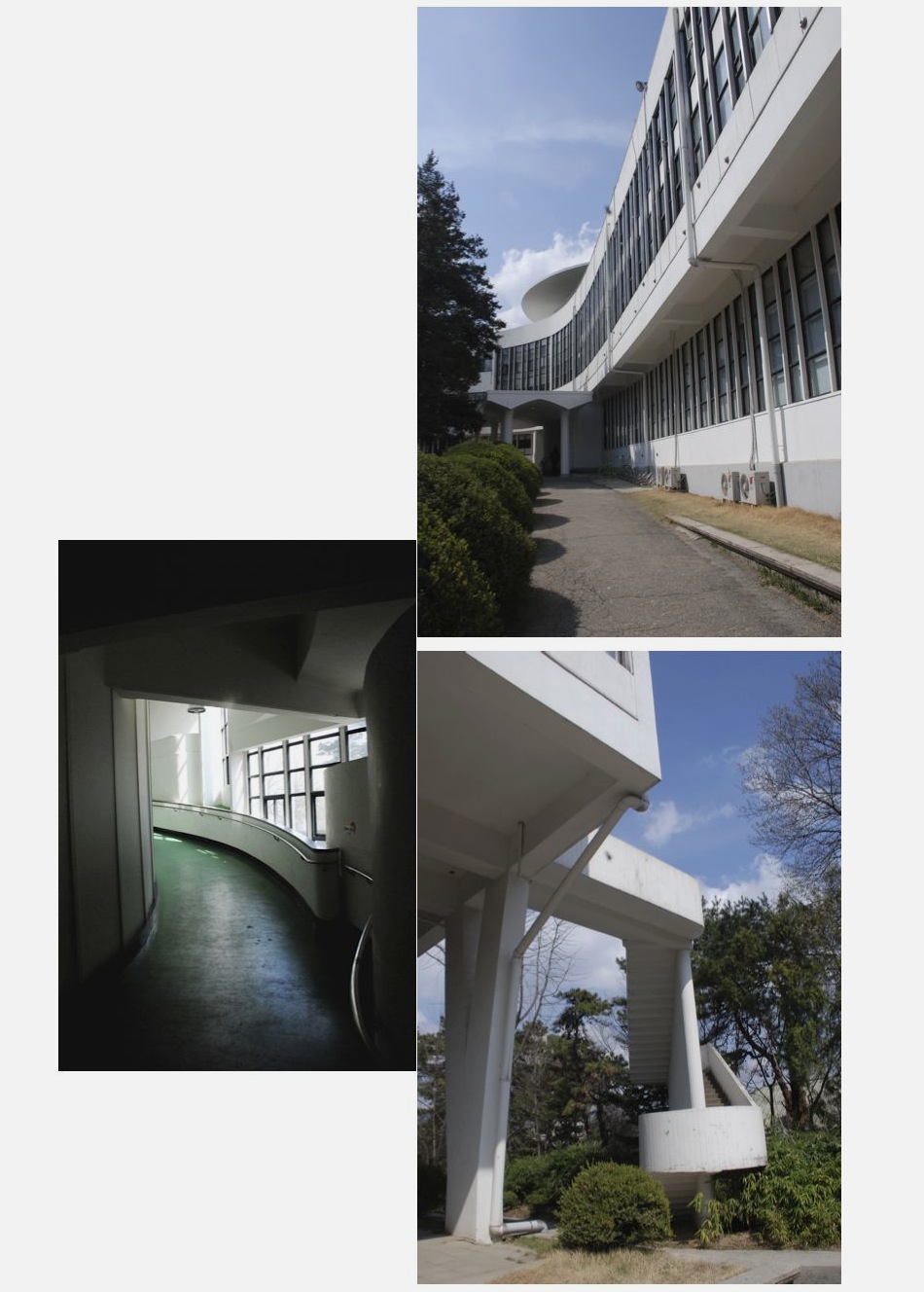
The highest topographical elevation on the Konkuk University campus in Seoul is punctuated with an oddly curious building, projecting an aesthetic and form caught somewhere between Corbusian modern and Eastern Block socialist architecture of the 1960's. The designing Korean architect in fact had studied briefly under Le Corbusier and was undoubtedly influenced in the outcome of what stands today. The building functions now as the campus' foreign language institute but in the recent past served as the school's main library. 

It's exterior white-washed walls have recorded seasonal time with weathered streaks and accumulated dust. The interior, while dated opposite outside, has recently undergone a fresh coat of refurbishment. Painted corridors and newly tiled floors attempt to conceal time. As I moved around the central, spiraling corridor I can't help but remember the long extended corridors of the communist panel-laks of Eastern Europe. Clouded windows, with the collected haze of season's and lives past to my right, mysteriously concealed, oblique spaces to my left; urban memory and the making of myths. 


Condencity_42 long city


Saewoon Sanga during the 1970's


The birth of modern architecture in Seoul was in part initiated by the construction of Saewoon Sanga in the mid 1960s. It's construction erased a half century of contentious urban 'vacancy' and representation. In the early 20th century a 1km strip of land was cleared by Japanese Colonial occupation and served as a fire break in the city during war time. After the Korean War, new urban settlers quickly constructed shanty villages and the area became known as the cities red light district. Rapid post war reconstruction of Seoul and a growing economy, fueled a burgeoning electronics industry and instigated needs for a larger modern market place. 

The vision for Saewoon Sanga by renowned Korean architect Kim Swoo Geun and city officials was thus an unprecedented mega-mixed use project of electronics commerce, educational and residential spaces, stretching the entire 1km. The ambitions of the project, while never fully materializing in diversity of mixed-use functions, did become the cities largest electronics market and most desirable residential address. Home to movie stars and corporate CEO's it's vibrant climax was quickly overcome by subsequent residential and electronics markets in other parts of Seoul. What has become today is a marginalized market of working class dwellers struggling to survive amidst a city that has quickly surpassed (and left behind) the advancements of what Saewoon Sanga once represented. 

Today, the mega-structure stands silently the same as it has for the past 45 years. Virtually unchanged and in disrepair its fate to demolition cranes apparently decided by the city of Seoul. This stretch of concrete form will once again become 'empty' as in urban park, dispersing its commercial tenants and residents of decades to other hidden corners of the city. It appears an un-thoughtfully simple solution for such a complex and fascinating place, to completely demolish the birth place of 'modern' in Seoul.


Condencity_41 dead ends


Night and day are reversed in the dead-end corners of Seoul. The sky exists as a night like grey metal cover with cool fluorescent eye-burning light. Just above, the day shines bright without notice. Narrow alleys pinch to shoulder width and terminate in shuttered doors. Boundaries of public and private space blur in obscurity and the chance to move forward is met with hesitation. Seoul's pulse are back alleys of work and mystery. 

Their presence, while here today appears to be something bordering the obsolete. As modernization of this city continues such curious roads are being raised and replaced with sterile glass towers. This road too has a finite future. In one form or another it will persist in our memories and imagination.


Seoul formless 2.2


Recently I have begun writing and researching about urban 'adaptations'. The economic machine of Seoul on a micro scale is evidence enough of how adaptable the generic office 'box' can be. With little regard for form or context the commercial shop adapts to any building location. Small spaces at the street front regularly appear and dissappear with the ebb and flo of economics. In return the street and city at large are constantly changed at face value.  Color, material and light exist apart from the building in which they are fashioned to.


Condencity_40 slim


San Francisco is attractively slim. It's the narrow lots wedged into city gaps and my memory that make it un-American; slim. Zero lot lines squeeze in to a nearly 'zero lot'. City often surprises us most when it reveals the least. An efficient use of space leaves much to the imagination. Stairs, Elevator, could it all be there?  The memory of yesterday simply exists for what is possible today.