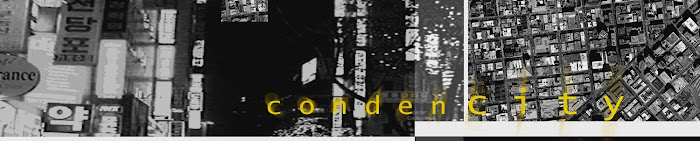
condenCITY_96 speculation city


You are here... or somewhere, as speculative chance amongst a city of muse. 

Viability is measured in paces from subway entrances and district identifiers- its all in a name after all. A city of speculative deals- one after another. Advertisement is the standout formula attempting to seduce and build distance from close by neighbors. The reality is there is little difference to be found and distance itself elusive. There is a certain mythology here- one of a different city (as in the rendered image above) in contrast to the one that exists in the reality of Seoul.

A city built on speculation. 


condenCITY_95 Futures uncertain


"Tsunami" effect.  

It is easy to make knee jerk analogies to Seoul's newest civic addition and its formal implications. Driving home the other night with two colleagues it was quickly agreed upon the failures this newly exposed addition lends to the cities public face. However, its formation as a monumental architecture- projecting the future and recognizing the cities tumultuous past- to me as a missed opportunity, is more confounding.


A strained attempt to unify a city and country? 

Our constructed public environments represent cultural outlook in progressive society. The progress under which, we are brought together in common visions and destinies (for better or worse). It is no secret that the design and construction of the Seoul city hall took a maligned route to completion- with competing factions in both government, construction companies and the designing Architectural firms. The worst of it seems to be that to this day there is no agreement or accountability on the part of anyone- while everyone sits and points fingers regarding the failures in design, budgets, and methods just to name a few. What has emerged though is a need for professional solidarity in the Architecture ranks here in Korea. Coming together as a professional body in order to instill safeguards of ownership, copy-write and legal matters of accountability. While these do exist to some degree one has to wonder then how so many of these issues could be blindly overlooked over the course of such a significant project. 

I ponder the future of this building 20, 30 years form now encumbered by the expression of its already dated, parametrically patterned skin.  How will it weather time- both in a  physical and formal sense? How will city hall become one of the significant faces of Seoul?  

For now, embracing history and celebrating the future, this project today appears to obliterate both. 


Remembering Marker


La Jetee 1962, Chris Marker, Image source wikipedia commons


1921-2012 Chris Marker


Forever remembering time travel in black and white. 


Un-condensed rural 5.0


Western Lines

Androgynous-scape
Tethered to the past
unrealistic futures ahead
It is vista
that feeds imagination
and blurs recent memory
This road is a place of endurance

My roots

A reflection of constant 
in Motion

Time has ancient wisdom here
Crosscuts before man
And after death
A series of lines
Carved in and suspended above earth
Structuring our west


condenCITY_94 temporary foundations


World expositions are an odd way, if not superficial method, of generating\ regenerating cities and urban areas in decline; a form of instantaneous urbanization and in the case of Yeosu, South Korea- the site of the 2012 World Exposition- it appears at face value as simple as adding water.  A maritime overture is interesting in reflection of the areas history but has repositioned the industrial waterfront for an uncertain future. Suggestive materializations today are the temporary foundations for tomorrow. 


condenCITY_93 modern perspectives


In 1986, the father of Korean modern Architecture passed away during the peak of his career at the untimely age of 55. Last year (May-July 2011) a retrospective exhibition of his works titled 'Dense Modernities' opened in Germany to the question- would Swoogeun Kim ever become globally known for his transformative contributions on the Korean peninsula? Perhaps in time the answer will emerge more definitively but for now, his aura remains predominantly domestic.   

Swoogeun Kim completed over 200 works in Korea and abroad. His fledgling practice began controversially at Buyeo (south of Seoul) for the design of the national museum seen in the above images. The museum stirred controversy in its reflectance of what critics saw as Japanese influence. Having less than two decades separation from the end of Japanese colonial rule, the suggestive, if not symbolic design of the museum was enough to raise discontent. Still, Swoogeuns vision prevailed and today it stands testament to willful evolution. 


The impassable homogeneity of Korean 'architecture' as it was, prior to modernizing efforts- Swoogeun forged a broadening vision- metaphorically and experientially. Carving away at the 'mass' he commanded views beyond borders. Swooguen looked to the outside and in doing so, brought a sequestered culture and population with him. His architecture remains to this day a model for resonant perspectives.


Un-condensed rural 4.0


In Time
The crevice accepts the water freely
Feeding the undoing of everything 
Beautiful.
Wood remains in decades wake
Hands Mark- stained by touch
Foot steps
deepen 
In time
The house of aristocrats
The house of passing glances.


condenCITY_92 preservative measures


photos: b.oicherman\\ e.reeder


Recently I have been collaborating with color and light expert Boris Oicherman, a visiting artist in residence at the Chungdam Institute- supported in part by the Museum of Contemporary Art of Seoul. We have been experimenting with a material he has become quite familiar with in his studio- cellophane- and together have begun to consider the effects of site specific installations in the dense, aging neighborhoods of Seoul's industrial urban center.  

Some of our first documented installation 'tests', seen here, are from my perspective an attempt to preserve 'city' via material interventions that promote heightened awareness through diverging contrast. Time will end for these dense network alleys, as Seoul moves forward- in blind obliteration- away from its tumultuous past. We can manage however to capture, with serendipitous effort- images, reflections, saturations otherwise overlooked-  as measures preserved for time immemorial. Perhaps similar in the way we have become accustomed to preservation; wrapped and sealed.


Un-condensed rural 3.0


Heyri art valley is located  to the north west of Seoul, just shy of the DMZ border. Planned as an artists live-work village it has become something of a commercial spectacle. Actually, suburban theme park comes to my mind, the more I return and experience the ebb and flow of 'customers' who visit in high volume on weekends and holidays- it is a place defined by being open and being closed, figuratively speaking. Heyri's North American suburban like planning, with meandering roads circling back to a single gated-community-entry, is dotted with modernist galleries, restaurants, residences,  working studios and a few other out of the ordinary functions. Natural landscapes permeate vacant lots and surrounding hillsides- all appearing in wait for the next architectural surprise- but one has to hope that some of this remains 'open' to dormant speculation. 


In Heyri, the sum of its pieces detract from the spirit of its whole. As place of creative discovery one is constantly distracted by competing architectural folly- even in recognizing the masterful results as some individual architectures have come to be. Beauty may lie individually, but excess can be blinding. Sometimes restrained silence is necessary: but what does this mean for the future of Heyri.. and after a decade of development and change has Heyri lost its way?