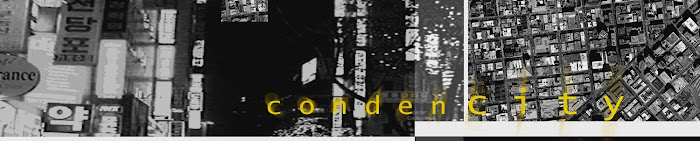
Yesterday I left Seoul and entered the city of shadow. Constructed entirely of its history as it was and as it remains. Bound in starkly banal newness this city stands apart. Defined by neighbors of contrast working side by side. The narrow streets recede in shadow to depths at times unknown and unseen. Light penetrates only so far to stir our imaginations. By invitation we enter and bypass the ground level activity. Blue sky gives way to encrusted corridor and each door with its cast of characters remaining as mysterious as the street below.
Showing posts with label 1930's Seoul. Show all posts
Seoul Formless_2.1
With each step we experience the rise and fall of Seoul's urban topography. The city is shaped by contours, viewed through pedestrian spaces of yesterday and today. Links between here and there are captured in laborious step and breath. With few exceptions the architecture and buildings that dress these slopes do so in clustered masses of indeterminate form; hillsides are blanketed with irregularity and density.
The city is experienced in actions. Carefully aware of the irregular rise from step to step, one is reminded of natures imperfections and the city as a place of formless possibility to mirror that of nature.
Labels:
1930's Seoul,
Bukchon Village,
Samcheong Dong
1930's Seoul_ projecting forward
The Hankok is a centuries old tradition of residential typology here in Korea. It's urban form in Seoul proliferated the city beginning in the early 20th century. It evolved from it's rural roots, providing a kind of suburban neighborhood to Seoulites until the multi-story apartment began to appear in the early 1960's. As a sustainable residential type it has evolved today as primarily an aesthetic and social icon, disappearing as a once functional neighborhood unit. Today, while several districts of the Hanok remain, the transformation of social and physical realities are starkly real and these once vibrant places stand as quiet glimpses of the past. Dwellings are rapidly converted to commercial interest and the remaining residences stand empty as owners choose to live elsewhere with modern comforts and conveniences. Economics have further eroded communities and populations have sold in interest of profits or have been forced to leave due to rising values. What remains is a kind of frozen urban museum; raising questions of the future of a regionally timeless way of building.
Subscribe to:
Posts (Atom)

