
Showing posts with label Gwangju. Show all posts

condenCITY_52 tattered edges


Gwangju in the far south on the Korean peninsula is a city seeking identity. In recent years its outwardly expansive growth has sought to create a new urban center for business, residence as well as renewed image for the city in general. This growth to the western urban edge has now joined efforts with the Korean governments recent campaign to redevelop the four major rivers throughout the country. Political argument has it that redeveloping the river corridors will attract tourism and protect urban areas from flooding. Read more on the history of the projects here at the Joongang Daily. 

Whats most shocking is the processional erasure of natural habitat presently being bulldozed in the name of 'restoration'. Design and development needs to have its limits (if this can even be classified as design). The river corridors are home and habitat to migratory Egrets and various other species now threatened by habitat destruction. The natural 'design' of such places should remain just that. No amount of beautification can claim progress over what nature can accomplish rightly on its own; and the projects are just that unsightly beautification.



Un-condensed rural 1.0


I'm not going to use the words 'green' or 'sustainable'. Truly we have always know of these ideas, lived them to a larger extent (in many cultures around the world) without the commercialized use of these terms, without the "greening" of anything. So how have we forgotten about these basics of life? How have we forgotten what it means to be a part of our environment so seamlessly? These are fundamental questions that seem easily exposed when visiting places inherently part of a larger system. 

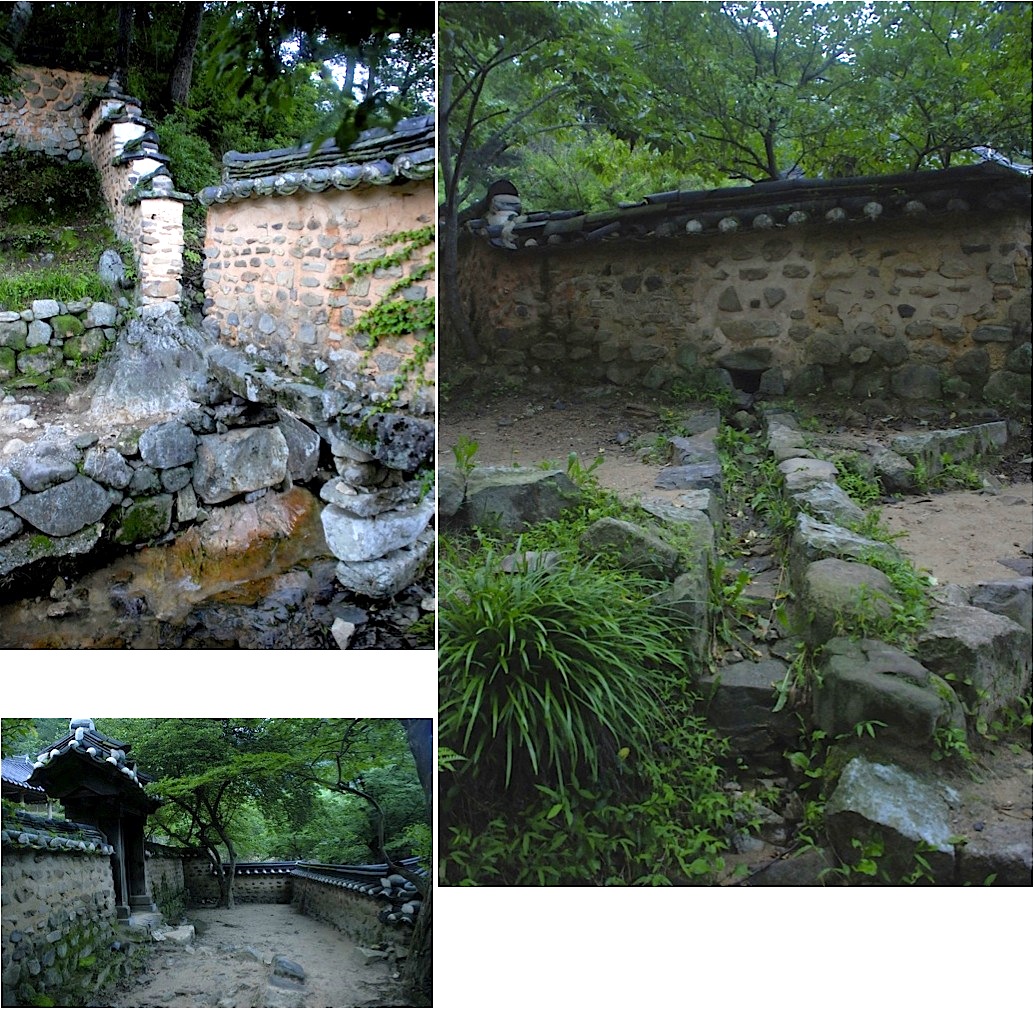
I recently revisited a historic garden in the far south on the Korean peninsula. Maintained for over five hundred years, Soswaewon has passed through successive generations as a place of seclusion, meditation and scholarly discourse. It has passed through the hands of political outcasts, scholars, invading governments (Japan) and was subsequently rebuilt after Colonial destruction.  In Korea, it is one of the most recognized historical places of its kind and continues to represent uncompromising points of view regarding 'constructing' in the context of nature. Balance has been established through relationships. 

Soswaewon is composed of a meandering wall which, encloses the garden on all sides except to the southeast where the site is bound by a small creek. The wall shifts from edge boundary to internal divisor and in doing so separates a small structure (a residence of the host) situated at the highest elevation in the garden. An even smaller residence for a guest placed at the lowest elevation just below the hosts house.  At the middle of the garden the wall encloses a small outdoor space of meditation, or what one can assume was the past function of this 'outdoor room'. The wall continues to transform over the restricted distance of the valleys shifting topography, giving way to altered functions. The wall rises and falls, responding to both nature and human necessity.  Its function oscillating between boundary and permeability, being seen and being invisible, exposing and concealing. The expression of which is a clear reflection of a balanced existence. 


Earth work memorial


Autumn is about memory here. The rural landscape in Korea is reminder of generations past and it is during this time, earth-forms [burial grounds] appear pronounced in the mountainous countryside terrain. At the annual harvest moon, families pay respect to ancestral sites overlooking vast valleys of rice fields and beyond. Like faces from the past these sculpted forms look onward, forever burned in memory.