Un-condensed rural 1.0


I'm not going to use the words 'green' or 'sustainable'. Truly we have always know of these ideas, lived them to a larger extent (in many cultures around the world) without the commercialized use of these terms, without the "greening" of anything. So how have we forgotten about these basics of life? How have we forgotten what it means to be a part of our environment so seamlessly? These are fundamental questions that seem easily exposed when visiting places inherently part of a larger system. 

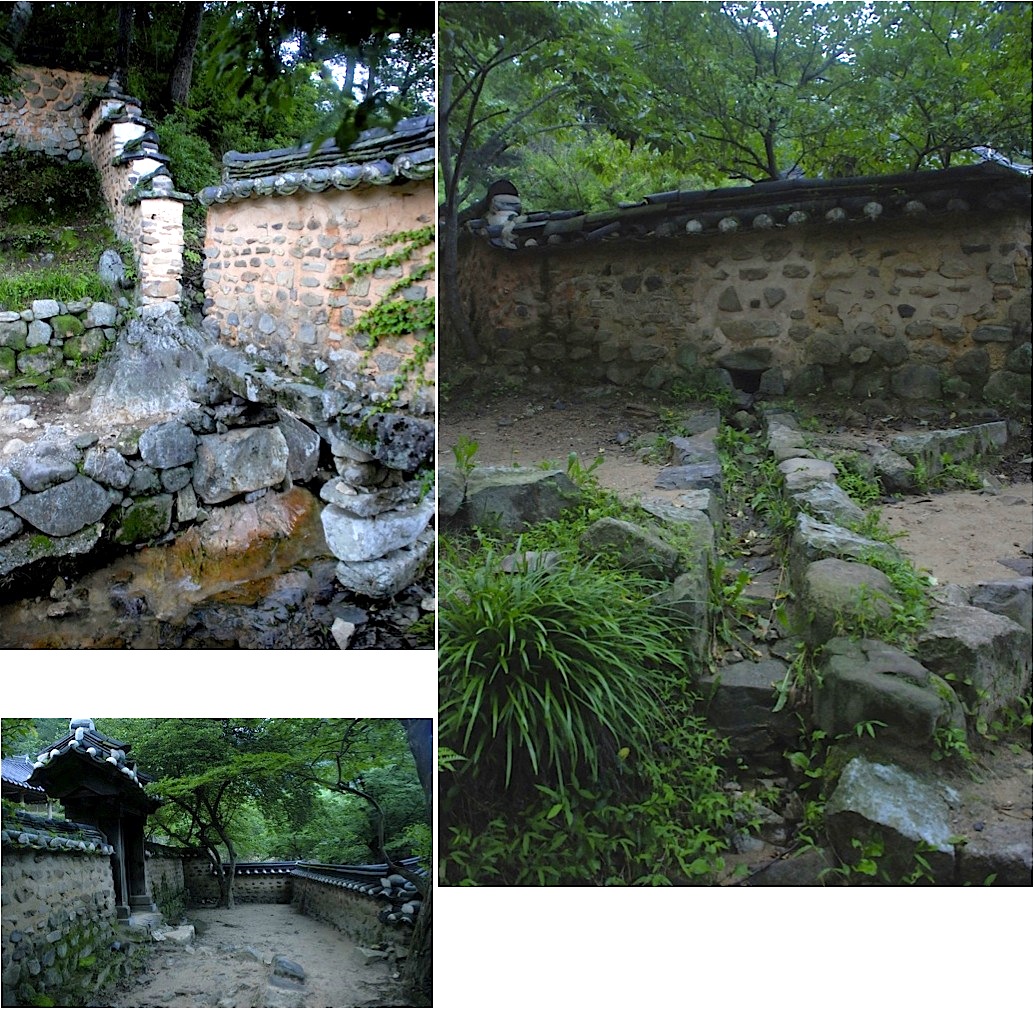
I recently revisited a historic garden in the far south on the Korean peninsula. Maintained for over five hundred years, Soswaewon has passed through successive generations as a place of seclusion, meditation and scholarly discourse. It has passed through the hands of political outcasts, scholars, invading governments (Japan) and was subsequently rebuilt after Colonial destruction.  In Korea, it is one of the most recognized historical places of its kind and continues to represent uncompromising points of view regarding 'constructing' in the context of nature. Balance has been established through relationships. 

Soswaewon is composed of a meandering wall which, encloses the garden on all sides except to the southeast where the site is bound by a small creek. The wall shifts from edge boundary to internal divisor and in doing so separates a small structure (a residence of the host) situated at the highest elevation in the garden. An even smaller residence for a guest placed at the lowest elevation just below the hosts house.  At the middle of the garden the wall encloses a small outdoor space of meditation, or what one can assume was the past function of this 'outdoor room'. The wall continues to transform over the restricted distance of the valleys shifting topography, giving way to altered functions. The wall rises and falls, responding to both nature and human necessity.  Its function oscillating between boundary and permeability, being seen and being invisible, exposing and concealing. The expression of which is a clear reflection of a balanced existence. 


condenCITY_51 lost city


 Namdaemoon destruction and reconstruction: images courtesy Chosun Ilbo

Just over two years ago an arsonist set fire to Sungnyemun on Feb. 11, 2008. Korea's No. 1 national treasure was burned with almost 70% (as reported in the news) total destructive damage to original wood structure with the entire second level of the ancient city gate known as Namdaemun being destroyed. Sungnyemun was originally constructed in 1396. The reconstructive efforts have exposed newly unearthed original foundation stones dating back to the early period of the Joseon Dynasty.

The newly discovered foundations have also revealed discrepancies in what was thought to be the original elevation of the old city gate. Excavation experts have noted that the current ground level around the historic structure is approximately 1.4 meters higher than the orginal ground elevation, obscuring the original foundation stones. As reported researches will now document the gates height at 8 meters obove sea level.


condenCITY_50 seoul adaptations 1.0


 Jong-gak 2002


 I took this photo in the winter of 2002 while living in Seoul. While so much has changed here, so much hasn't. In 2002, this perspective of commercial Seoul represented to me all that was different here regarding the urban condition; so much so it is still at the forethought of my interest in Seoul as a place of urban adaptations. Buildings and commercial structures are 'soft surfaces' (and for the most part irrelevant in design) readily manipulated, covered and altered. The base surface rendered obsolete, unnecessary beyond that of supporting facade and malleable interior space.

Nearly eight years later, a visit to this part of the city reveals the same invisible buildings and structures with new faces. Much that was there in 2002 has given way to remodel storefronts, new tenants or other altered cosmetic change (inevitable in commercially economies). The collective transformation of such districts changes our overall perception of the  city; our memories of the past clouded with surface adaptations.


Seoul formless_2.3


Namdaemoon 1904

Many discussions were held this semester about the historic 'plan' of Seoul. Perhaps more succinctly was the lack there of. Seoul's earliest beginnings excluded any semblance of urban planning. The urban form which emerged at the turn of the 20th century was the result of land ownership and negotiated, sometimes indistinctly blurred boundaries. 

Seoul could be described as a city in reverse. Its roads and thorough fares, by-products of an indigenous architecture and building 'mass'. Viewed another way, the city streets and routes came second. Cities, as we known them in many other places (as in western cities), are often the direct result of planned efforts forged of transportation routes and zoned districts.

Seoul, it seems is exactly opposite.


condenCITY_49 long city 2.0


The final days of each semester seem to expose more questions than answers but perhaps this should be the goal of any studio objective; establishing questions which then become seeds of interest for lifelong journey's and investigations. This semester my students have been challenging Seoul's decision to demolish Saewoon Sanga and replace the 40 year old structure with park space. (See thoughts on Saewoon from previous words condenCITY_42.)

The contention that this mega-structure is a vital part of the cities rapid transformation (although recent history has rendered the building obsolete) and in part can become a continuation of Seoul's history and future. Student projects considered urban as well as architectural issues at divergent (and relevant) scales. Project proposals instigated ideas for temporary and in themselves transformable solutions, recognizing the ever evolving nature of Seoul and the emerging questions 'how do we respond to the these rapid changes' and 'how can we consider existing structure as relevant and adaptable as opposed to expendable' (which is often the case here in Seoul). 

The above works were completed by Hanyang University students Eun Hee Lee, Jong Hyun Kim and Hyun Kim from top to bottom respectively. 


condenCITY_48 Vertical life 2.0


The apartment phenomenon and proliferation has transformed the face of Seoul. There is no other building type that has so drastically shaped the image and form of Seoul. Its current (yet loosely defined) life cycle stands at around 35 years after which entire complexes and numerous apartment units fall to the demolition crane. The first generation of such apartment complexes in Seoul's southern urban districts have already begun to be redeveloped, with aging buildings being replaced with higher density developments. 

Banpo Dong's apartment explosion began in the 1970's. Lining the Han River on the south side of the city, thousands of apartments of this residential district await 'ugrades' with apartment dwellers sometimes divided about being displaced, often with economic incentives spearheading disputes and holdouts (there has to be unanimous agreement amongst current dwellers prior to any redevelopment). The Shin Banpo is one such complex at the twilight of its lifespan. 

Apartment blocks in Seoul are places of homogeniety. Individuality is camouflaged amongst drab concrete slabs dressed in standard neutral beige. The apartment phenomenon has been the center of cultural debate as such residential conditions seem to skirt the very traditions of social contact and place identity here in Korea. Conditions that seem long lost in Seoul's quest to house exploding urban populations of the past forty years. While measures to improve such developments in recent times have been to improve housing design and livable conditions, ironically (as in most sub-urban residential developments anywhere in the world) implemented codes and zoning instill a cycle of stifled potential in advancing such residential models. The results are often more of the same as prescribed by written laws.


condenCITY_47 urban dinosaur


The Seoul Express Bus Terminal in Gangnam opened in 1985. City plans have already tagged the building for removal and reconstruction within the next ten years. Like most construction in Seoul, its hulking mass of weighted concrete is oppressive and awkward at best. A walk around the dated structure seems more like 1960 as opposed to something of a 1980's creation. Oddly though, its oddity is precisely it's appeal. 

Entering on either the east or west sides of the building takes you through oversized arcades ( the most interesting spatial experiences at the terminal ) situated at the buildings edges and defined by massive concrete columns extending to foundation.  The spaces are well kept and appear in a continual state of mopped-over preservation, presumably as they have for the past twenty five years.  


Even when open the terminal appears closed. Passengers are funneled down the long flanking sides of the building to entries well concealed and curiously hidden from street view. It was months after living here I realized the terminal was in operation.  Its fortified appearance imposes an impenetrable impression, standing as apparition within the bustle of the busiest bus and subway depot in the city.


condenCITY_46 relative cities : irrelevant form


 image courtesy wiki commons


The 193 km (120 miles) that separate Seoul, South Korea and Pyongyang, North Korea couldn't seem greater if the two cities were actually opposite poles of the planet. With some effort it is possible for foreigners to visit Pyongyang but for now, I am stuck with imagining what the city must like. A unified Korea and seamless visit to Pyongyang seems equally impossible anytime in the foreseeable future. I am left to my imaginative devices but from what I have read and the photos I have seen, there are remarkable similarities between the architectural 'technique' in cities of the north and cities here in the south. Korean architecture is intensely 'form' driven. Seoul is testament to that. The culmination of such projections perhaps is even more evident in the Ryugyong Hotel located in the North Korean capital.

The Ryugyong Hotel construction began in 1987 but was abruptly halted in 1992 amidst the North's  severe economic troubles. The construction of the mega-structure has remained on hold since 1992 however, recent investment has renewed efforts to complete the out-of-place building.  After nearly 16 years, in early 2008, foreign investors and political motivation allowed construction to restart.  The structural skeleton of Ryugyong stands at 105 floors and was initially built to attract foreign investors, dignitaries and guests who would stay in anyone of the staggering 3000 hotel rooms. There have been questions about construction quality and even structural integrity of the building with claims the elevator shafts are misaligned, yet its looming completion pushes on.

The construction now has been projected to be complete by 2012, coinciding with government celebrations marking the 100 year anniversary of the late communist leader (the father of Kim Jong Il). With populations of starving citizens one has to question the motivation of a government to put perverse architectural form ahead of dying social need. Since when have cities been places of equality though? Speculation is, the work now being done is nothing more than an aesthetic 'skin', covering what will remain an empty, non functional building.


condenCITY_45 transitions


May 
transitions
hard line
between winter chill
summer heat
caught between light 
and rising steam 
public dimensions
drift in and out
of negotiated
boundary


Seoul Formless_adaptations


Architecture just happens. 

It is the adaptable forms of the city which shape the everyday pedestrian experience in Seoul. Makeshift structures identify as utilitarian only and yet account for much of the cities outward aesthetic. Such small buildings represent Seoul's "commando" approach to urban development (which through the 20th century drove Seoul's quick modernization), whereby necessity and function have clouded any consideration of 'planned'.  

Seoul is evolutionary.