

Ai Wei Wei “Love the Future” (爱未来)

Image courtesy from the web BBC
The detaining of artist and activist Ai Weiwei by the Chinese government earlier this week has sparked nations and citizens from around the world to demand his release. Outspoken in his views of the Chinese government, Ai's work has come to represent a national conscious, stoking awareness of human rights. The son of one of China's most revered poets, Ai himself has in his 30 year career gained a cult like notoriety with installations and works spanning media and continents. He is well remembered for his collaboration on the Beijing Olympic stadium with Architects Herzog and de Meuron but perhaps more importantly his efforts to expose the recklessness of a government against its people upon the completion of the project.
His recent disappearance is sure to solidify his persona and one might speculate his personal agenda in awakening the suppressed spirit of a nation. This could be his biggest work to date.
condenCITY_65 urban green space

Green space is redefined in Seoul, with all of the environmentally conscience advantages to go with it. Packed in tight lots throughout the city are multi-story driving ranges, free from the burdens and labors landscape care and excessive water use. These diaphanous green giants, boasting lightweight space frames and strikingly green nets, are second home to thousands of golf fanatics who stand on its platform edges both day and night, gazing out into the urban-wilderness.
Seoul green space.
Seoul green space.
Lost Cities (to be rediscovered in time)

In the wake of the massive 8.9 quake and ensuing tsunami that struck Japan on Friday the 11th of March is certainly cause for contemplation. Being within a stones throw from Japan here in Korea, of one of the more seismically active regions on the planet. The incomprehensible carnage left by the trembler and tsunami, caused the north eastern Japanese coastline to be displaced by an estimated 8 feet (2.4m) and vast areas of towns and cities leveled.
Earthquake and tsunami preparations in Japan are amongst the most stringent in the world. Tokyo's ability to survive largely in tact in the aftermath, might be testament to this. With substantial damages to be sure, the mega-city of Tokyo, considering what might have been with out such rigorous seismic standards, would have been much more serious comparatively in other parts of the world. It is stammering, for example, to think about such a quake in California and in retrospect of Japan's tragic experience, should provoke an awakening of response in other parts of the world with similar earthquake potential.
We may look to Japan, as we have in decades past, for innovations in Architecture and perhaps the thoughtful approaches to 'details' in modern life. I consider now the future of a design profession and the creative responses to be seen in coming years, as a country rebuilds and again, as it has had to in the past, critically rediscovers and shapes the future of cities worldwide.
condenCITY_64 city of shadows 1.0

Yesterday I left Seoul and entered the city of shadow. Constructed entirely of its history as it was and as it remains. Bound in starkly banal newness this city stands apart. Defined by neighbors of contrast working side by side. The narrow streets recede in shadow to depths at times unknown and unseen. Light penetrates only so far to stir our imaginations. By invitation we enter and bypass the ground level activity. Blue sky gives way to encrusted corridor and each door with its cast of characters remaining as mysterious as the street below.
Roche: generations + works

Knights of Columbus Building, New Haven, Connecticut, image courtesy wiki commons
I was reminded yesterday of a conversation I had years back when reading a non-related New York Times article featuring the achievements of modernist Architect, Kevin Roche. The divisive conversation took place in an informal design review at a former office of mine, with an ensuing discussion regarding relevant parking garages as precedent for a design commission in San Francisco, California. My colleagues at the time were flippant at the idea of considering the importance of the New Haven Veterans Memorial Coliseum and the attached parking structure, which to me represented a critical example of the tectonic and monumental (as in architecture) combined in a manner relevant even today. For my colleagues the parking structures non-glamorous, 'ugly image' was of a flatly knee-jerk response. Frankly, their non-critical "general public" position was a hollow argument (shocking to me being in a 'design' office) and enough for me to let a dead-end conversation lie flat... in any event...
The attraction of the firms 60's and 70's works, during the heyday of Roche Dinkeloo Architects, was an evident desire to extend architecture beyond site; engaging a number of their projects in urban reference both literally, perhaps in the surreal spectacle in the forms they created and clearly too, in methods embracing delicate cultural and functional identities of the time, revealed through 'details' in their work.
Mr. Roche was once quoted as saying in an interview, a "highway scale" was influential in a number of their projects and evidently so in the New Haven Coliseum. It was an innovative project that overcame a high water table site constraint by relocating the parking program to the emblematic elevated position for which the Architecture became known for. (Which, by the way, was unfortunately demolished in 2007. Limited public funding had let the building deteriorate to the point of New Havens refusal to sufficiently fund and refurbish the aging structure). More can be read about the work of Kevin Roche and John Dinkeloo in a Kevin Roche interview on Archinect.
I have never known Mr. Roche in person although, I feel as though I do, having befriended his daughter Alice in graduate school at Berkeley. Testament (and compliments) to thought filled generations and visions at polar opposites at a spectrum of scales.
condenCITY_63 Urban Factories

A new exhibition in New York at the Skyscraper Museum titled 'Vertical Urban Factory' recently peaked my interest as I examine similar conditions here in Seoul with regards to shifting industrial zones in the city (and what is ultimately left behind as industry relocates to the urban periphery). There is a good article at the Architects Newspaper that reviews the NYC exhibition and brings to light conditions today and more pointedly through the twentieth century of factories in the urban center.
Not surprisingly is the differences between factories and districts of industry in Seoul in contrast to the western equivalent which has revealed more integral forms in aging city-scapes. In Seoul, the integration is more complex perhaps and regarded with less long term value and questionable overall contributions to the urban fabric. The social components of such conditions are still undeniable as workers and supporting businesses shape the city in ways unique to industrial process.
With the displacement of industry anywhere and factories that remain, choices persist as these places rest idle.


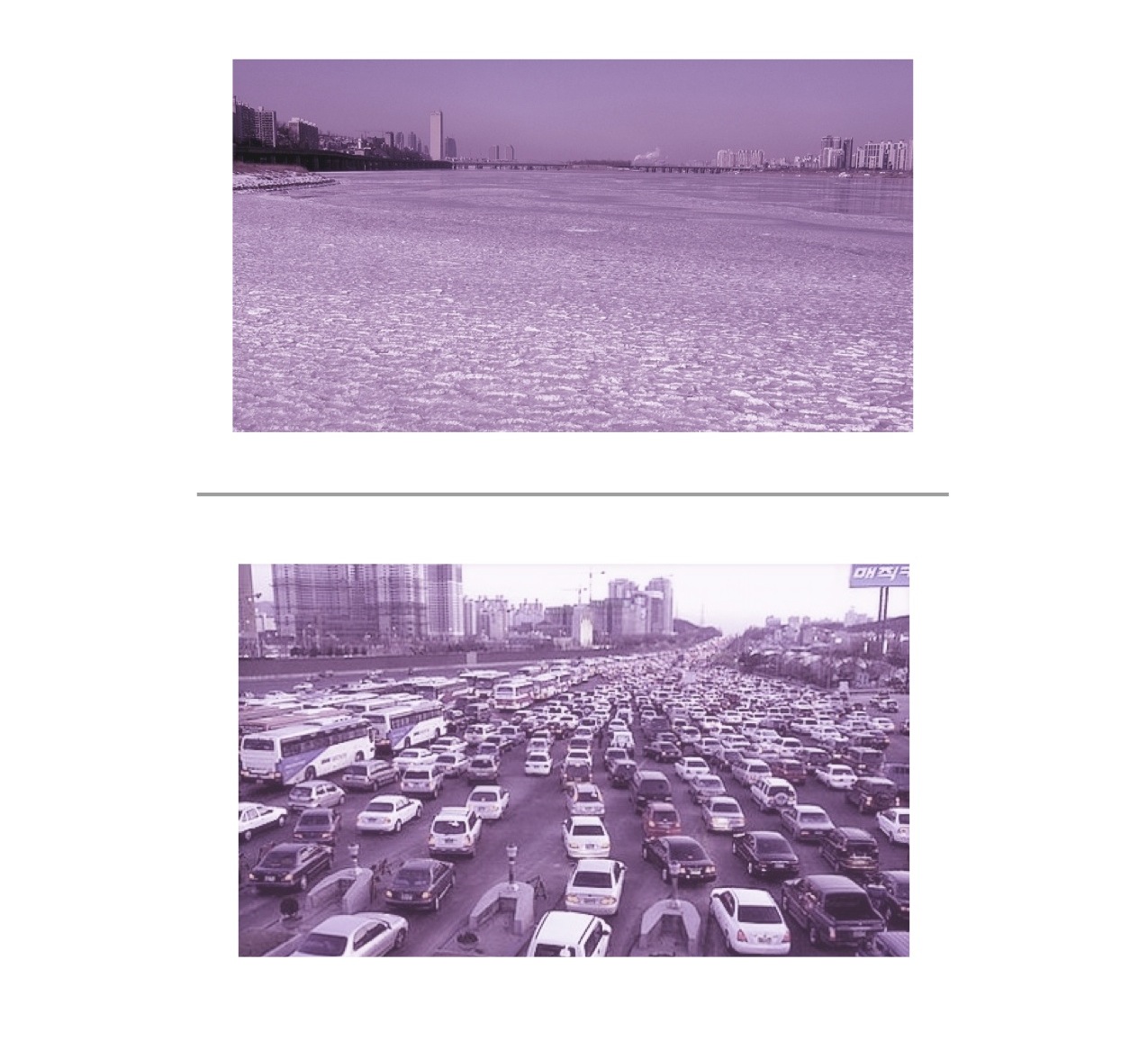


Calvino's Seoul

"Cities, like dreams, are made of desires and fears, even if the thread of their discourse is secret, their rules are absurd, their perspectives deceitful, and everything conceals something else."
-Italo Calvino, Invisible Cities
Subscribe to:
Posts (Atom)